Integrated security management (ISMS) links CCTV, access control, intrusion detection, and building systems into one platform so operators watch, verify, and respond from a single console instead of switching between disconnected tools. The payoff is faster incident verification, fewer false alarms, and an auditable event trail that satisfies compliance reviews. This guide breaks down the features to demand, the architecture that scales, and the checklist that keeps a rollout from becoming a budget disaster.
TL;DR:
- Real-time monitoring must be managed through a unified console with automated event-driven camera call-up and escalation workflows.
- Integration architecture should rely on standardized connectors and gateways, with a unified event layer and documented APIs to ensure scalability and support phased migrations.
- Successful implementation requires a risk-based master plan, phased deployment, comprehensive operator training, and clear KPIs to control costs and ensure operational readiness.
- Clear scope in physical infrastructure installation, including cabling and network support, is critical because the core challenge lies in supporting reliable data flow for the platform.
- Smaller organizations should evaluate AI-enabled platforms with live demos using their own equipment to confirm accurate alarm triage and avoid unreliable false-positive filtering.
Table of Contents
- What Features Should You Require From an ISMS?
- How Does Integrated Security Management Improve Operations and ROI?
- Which Integration Architecture Scales Best?
- How Do You Plan and Deploy an Integrated Security Management System?
- What Integration Mistakes Should You Avoid?
- Why Fiber Tech Solutions Is a Qualified ISMS Delivery Partner
- Does Integrated Security Management Work for Smaller Organizations?
- What Compliance Requirements Apply to Integrated Security Management?
- How Do Data Privacy and Cybersecurity Affect Integrated Systems?
- Where Has Integrated Security Management Delivered Results?
- The Real Gap Between ISMS Marketing and ISMS Delivery
- Get Your Integrated Security Management System Designed and Installed
- Sources
What Features Should You Require From an ISMS?
A real integrated security management system does more than pipe camera feeds into one screen. Vendors love to call basic video walls "integration." Push past the marketing and check for these capabilities during RFPs and live demos:
- Real-time monitoring with a unified console that lets one operator manage alarms, cameras, and access events without toggling between separate applications.
- Video analytics tied to event-driven camera call-up, so a forced-door alarm automatically pulls the nearest camera feed and timestamps it for evidence linking, an approach consistent with how consolidated platforms reduce reliance on multiple control panels.
- Centralized access control with full credential lifecycle management, covering issuance, HR-driven revocation, and multi-site card or biometric provisioning. Enterprise platforms like Siemens' SiPass integrated show what this looks like in practice, with automated workflows and audit trails built in.
- Automated alarm workflows with escalation rules, routing an unacknowledged alert to a supervisor after a set time window instead of letting it sit in a queue.
- Building management system (BMS) integration, so HVAC shutdowns, fire panel triggers, or elevator lockdowns fire automatically when a security event crosses a defined threshold.
- Reporting and scalability, meaning the platform can add sites, cameras, or door controllers without a forklift upgrade.
Ask any vendor to demonstrate each of these live, not in a slide deck. If they cannot show automated escalation working end to end, that gap becomes your problem after go-live.
How Does Integrated Security Management Improve Operations and ROI?
The financial case for integrated security management rests on fewer wasted labor hours and cleaner audit evidence, not just tighter security. When access control, video, and intrusion sensors report into one system, guards stop chasing separate alarm panels and start reviewing correlated events.
Consolidation directly reduces false alarms and shortens investigation time because operators see linked video and access logs instead of piecing together timestamps from three systems by hand. That single change often does more for response time than any amount of extra staffing.
Operational gains typically show up in four places:
- Faster incident verification, since one alert carries its own video and access context.
- Lower operating costs from consolidated monitoring stations and fewer redundant licenses.
- Stronger compliance evidence, with time-stamped, cross-referenced logs ready for audit.
- Better multi-site oversight, letting one regional security manager cover several facilities from a single dashboard.
Pro Tip: Ask for a sample incident report generated by the platform before you sign anything. If it takes a human analyst 20 minutes to assemble what should be automatic, the "integration" is cosmetic.
Which Integration Architecture Scales Best?
Buyers usually face a choice between one monolithic platform from a single vendor and a best-of-breed approach that stitches together specialized tools through APIs. Neither is universally right. A monolithic platform is easier to support and often cheaper to maintain long term, but it locks you into one vendor's roadmap. Best-of-breed keeps you flexible but multiplies the number of interfaces that can break during a firmware update.
The pattern that tends to work across both models is standardizing on connectors and gateways instead of custom-coding every link. Verified integration directories, like the ecosystem Hirsch maintains, let you check whether a camera brand or access panel already has a tested connector before you commit budget to custom development. That single step eliminates a large share of integration risk.
Three things separate a resilient architecture from a fragile one:
- A unified event layer. Every subsystem, video, access, intrusion, BMS, reports into one data model so operators correlate events without translating formats manually.
- Gateway-based legacy handling. Older access panels or analog camera runs get bridged through a gateway rather than ripped out on day one, which keeps capital costs manageable during a phased migration.
- Documented API contracts. Any integration should have a written spec for what data flows where, so a vendor swap five years from now does not require reverse-engineering the whole estate.
Pro Tip: Before signing a contract, request the platform's list of verified integrations in writing. A vendor that cannot produce one is asking you to fund the integration testing yourself.
How Do You Plan and Deploy an Integrated Security Management System?
A successful rollout follows a sequence, not a single big purchase decision. Skipping steps here is the single most common reason integration projects run over budget.
- Run a risk assessment and master plan first. Map which assets need protection, which doors and zones carry the highest risk, and which stakeholders (facilities, IT, security, compliance) need sign-off before procurement starts.
- Build a procurement checklist around interoperability. Require open APIs, documented cyber hygiene practices, patch management commitments, and clear SLAs for support response times.
- Deploy in phases. Pilot one building or one wing, test failover scenarios, and only expand once operators can run the system without a vendor engineer on standby.
- Train operators on real workflows, not feature tours. Run tabletop exercises using actual incident scenarios: a forced door at 2 a.m., a fire panel trigger during business hours.
- Move into steady-state operations with defined KPIs. Track mean time to acknowledge, false alarm rate, and system uptime monthly, not annually.
Budget planning should separate costs into distinct buckets:
- Hardware and licensing (cameras, panels, servers, software seats)
- Installation and cabling labor
- Integration and configuration work, including gateway licensing
- Training and change management
- Ongoing maintenance and lifecycle support, often the most underestimated line item
Managed services, where a contractor handles patching, health checks, and firmware updates under a maintenance agreement, are worth pricing separately rather than assuming your internal IT team will absorb them for free.
What Integration Mistakes Should You Avoid?
Most failed ISMS projects do not fail because of bad hardware. They fail because of predictable process gaps that show up months after go-live.
- Scope creep and over-customization, where every department wants a bespoke workflow, turning a six-month project into an eighteen-month one.
- Inconsistent event taxonomies, where "door forced" means one thing in the access system and something else in the reporting dashboard, breaking correlation.
- Weak operator training, leaving guards falling back on old habits and ignoring automated workflows the platform was built to handle.
- Hidden lifecycle costs, particularly vendor lock-in on proprietary hardware that makes future expansion expensive.
- Device cybersecurity and change control gaps, where cameras and panels ship with default credentials and nobody enforces a patch schedule.
The five pillars framework, planning, technology, people, procedures, and maintenance, exists specifically because integration failures usually trace back to skipping one of these, most often planning or maintenance.
Pro Tip: Write your event taxonomy on paper before any vendor touches configuration. A shared glossary of terms costs an afternoon and saves months of correlation headaches later.
Why Fiber Tech Solutions Is a Qualified ISMS Delivery Partner
Fiber Tech Solutions designs, installs, tests, and maintains the communications backbone that integrated security depends on, including CCTV and access control setup, structured cabling, and Integrated Building Management Systems alongside Integrated Security Management Systems. That combination matters because an ISMS is only as reliable as the fiber, copper, and ELV infrastructure carrying its signals.
The company brings IMDA-licensed contracting status, FOA-certified splicing and termination expertise, and more than 30 years of leadership experience across a track record spanning over 1,000 buildings in Singapore...
A typical engagement includes a site survey, a phased masterplan aligned to the five pillars above, staged rollout with operator training, and SLA-based maintenance once the system goes live..
| What You Get | Why It Matters |
|---|---|
| Site survey and risk-based masterplan | Prevents scope creep before contracts are signed |
| IMDA-licensed, FOA-certified installation teams | Reduces cabling and termination rework risk |
| CCTV, access control, and BMS integration | One contractor for the physical layer and the platform layer |
| Phased rollout with operator training | Avoids the workflow failures that derail go-live |
| SLA-based scheduled maintenance | Keeps lifecycle costs predictable after installation |
- Site survey and masterplan tied to actual risk exposure, not a generic template
- Certified splicing and termination for the fiber and copper backbone feeding cameras and panels
- Coordinated CCTV, access control, and BMS integration under one delivery team
Does Integrated Security Management Work for Smaller Organizations?
Integrated security management is not just an enterprise play anymore. Singapore's own SME guidance points smaller organizations toward AI-enabled ISMS platforms as a way to centralize monitoring and integrate third-party systems without building an in-house security operations center from scratch.
That matters for a facilities manager running two or three buildings who does not have budget for a dedicated SOC team. AI-enabled platforms increasingly handle first-pass alarm triage, flagging which alerts need human eyes and suppressing the noise that used to bury operators in false positives. The government program framing treats this as a practical adoption path rather than a luxury upgrade, which tracks with what smaller facilities actually need: fewer people watching more screens, correctly.
The caveat is that AI-enabled features are only as good as the event data feeding them. A platform trained on clean, consistently tagged events performs well. One fed inconsistent data from mismatched subsystems will flag noise as signal just as often as it filters it out. SMEs evaluating these platforms should ask vendors for a live demo using their own site's device mix, not a generic dataset, before assuming the AI layer will behave as advertised on day one.
What Compliance Requirements Apply to Integrated Security Management?
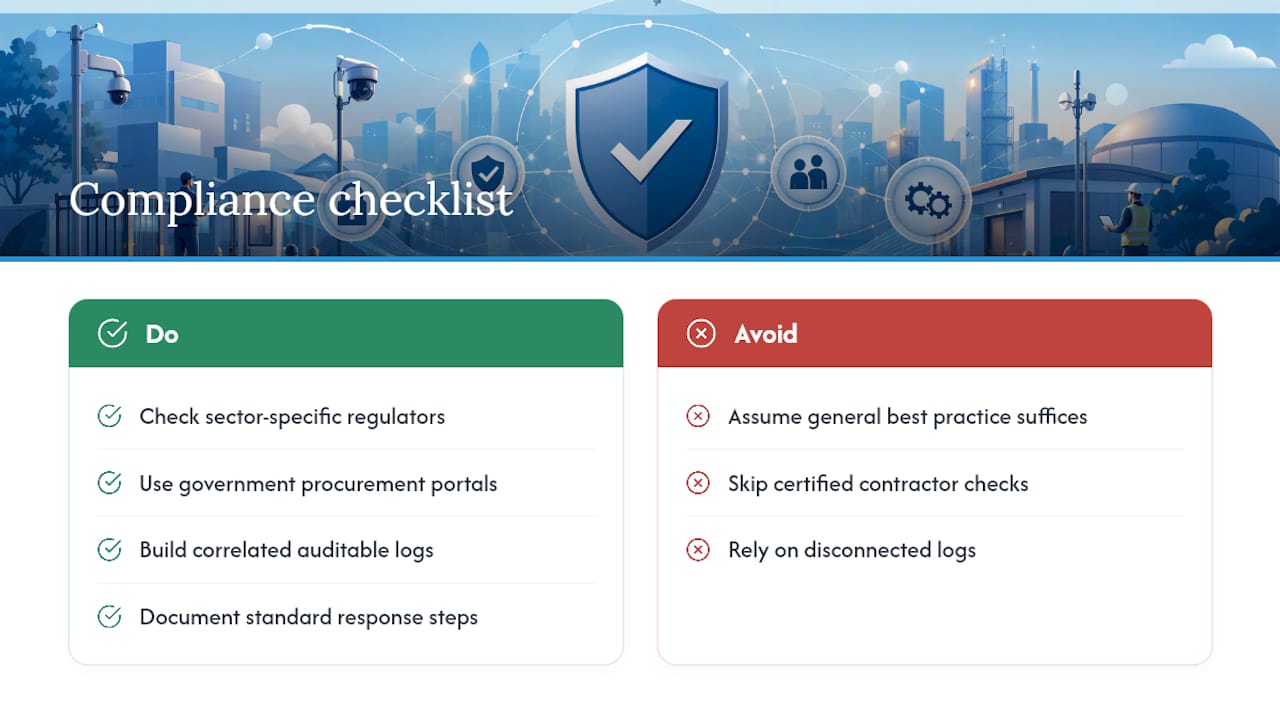
Compliance expectations for ISMS deployments usually come from two directions: sector-specific regulation and general data protection law. Facilities handling critical infrastructure, telecom exchanges, transit systems, airports, power substations, tend to carry stricter audit and reporting obligations than a standard commercial office.
An auditable event trail is one of the practical outputs of proper integration. When access logs, video timestamps, and alarm acknowledgments live in one correlated system, producing evidence for a compliance review takes minutes rather than a multi-day reconciliation exercise across disconnected logs. That is one of the more underrated reasons integration pays for itself: audits become less painful, not just faster.
Government portals and licensing bodies remain the right first stop when scoping compliance expectations for a specific project. In Singapore, IMDA's contact channels are a practical starting point for procurement rules and certified contractor requirements, particularly for telecommunications infrastructure tied into a security deployment. Facility owners in other regulated sectors should confirm sector-specific reporting obligations with their own governing body rather than assuming general security best practice covers every regulatory requirement.
Procedures matter as much as technology here. A platform can log everything perfectly and still fail an audit if nobody documented the standard response procedure operators were supposed to follow when an alarm fired.
How Do Data Privacy and Cybersecurity Affect Integrated Systems?
Every camera, access panel, and sensor connected to an ISMS is a network endpoint, and each one is a potential entry point if it ships with default credentials or unpatched firmware. Integration multiplies convenience and multiplies attack surface at the same time, which is why device cybersecurity deserves the same scrutiny as physical installation quality.
Privacy considerations run in parallel. Access logs, video footage, and biometric credential data are personal data under most privacy frameworks, which means retention policies, access permissions to the platform itself, and data export controls need to be defined before go-live, not patched in afterward.
Buyers should prefer architectures that keep a single, searchable event record for forensics rather than scattering logs across multiple disconnected consoles, since a fragmented log trail is harder to secure consistently and harder to produce cleanly during an incident investigation. That single-source approach also simplifies who has access to what, since permissions can be managed in one place instead of five.
Change control is the piece most projects skip. Every firmware update, every new camera added to the network, and every access panel swap should go through the same review process as a core IT system change. Treating security devices as "just hardware" rather than networked endpoints is how breaches happen on systems that were supposed to prevent them.
Where Has Integrated Security Management Delivered Results?
Airports, transit systems, and data centers are where integrated security management earns its reputation, because these sites cannot tolerate the lag time of manually cross-referencing separate systems during an incident. A transit depot with hundreds of access points and camera feeds needs an operator to see a forced-door alert with its corresponding video clip in seconds, not minutes, because the response window for a security breach in a live rail environment is measured in real time.
Data centers present a different pressure: uptime and chain-of-custody documentation for every physical access event, since a single unauthorized entry can trigger a client audit. Integration here means every badge swipe, every server room entry, and every environmental alarm from the BMS lands in one correlated log that satisfies both security review and client compliance requests without manual reconciliation.
Shipyards and industrial sites raise a different problem: harsh environments, confined spaces, and live operations happening around the security work itself. Systems installed here need to survive vibration, moisture, and dust while still integrating cleanly with the same access control and video backbone used in a climate-controlled office tower.
The common thread across every one of these environments is that integration does not just add convenience. It removes the manual correlation step that turns a fast-moving incident into a slow, error-prone investigation.
The Real Gap Between ISMS Marketing and ISMS Delivery
Most integrated security management content sells the dashboard. It shows a slick console with camera tiles and access logs and calls that "integration." What the marketing rarely mentions is that the console is the easy part. The hard part is the cabling, gateway configuration, and event taxonomy work happening underneath it, the stuff nobody photographs for a brochure.

The conventional advice tells buyers to focus on platform features first. That's backwards. Features are meaningless if the underlying infrastructure, the fiber runs, the panel wiring, the network segmentation, was installed without the integration in mind from day one. I'd argue the procurement checklist should start with the physical layer and work up to software, not the other way around, because retrofitting cabling after a platform choice is where budgets actually blow up.
What decision-makers should prioritize first is not which vendor has the flashiest analytics. It's whether the contractor doing the physical installation understands how that infrastructure needs to support correlated events later. Get that sequencing wrong and no amount of software sophistication fixes it.
— Samuel
Get Your Integrated Security Management System Designed and Installed
A qualified ISMS contractor handles the physical infrastructure connecting your cameras, access panels, and sensors into one working system. Some contractors provide design, installation, splicing, testing, and maintenance of the fiber, copper, and ELV backbone your ISMS runs on, and also integrate CCTV, access control, and building management layers on top of it.

That matters because a platform is only as reliable as the cabling and terminations behind it, and licensed teams with certified splicing expertise and relevant project experience are essential to that work. If you're planning an ISMS rollout and need a contractor who understands both the network layer and the security platform layer, start with a site survey through Fiber Tech Solutions to scope your masterplan before you commit to hardware.