Choose OSDP with Secure Channel enabled for any new or upgraded access control installation. It encrypts credential data with AES-128, supervises the wire for tampering, and carries the Security Industry Association's backing as the interoperability standard. Wiegand still has a place, but only where legacy hardware makes replacement impractical right now.
TL;DR:
- Upgrading to OSDP with Secure Channel ensures AES-128 encryption, wire supervision, and multi-vendor interoperability, unlike Wiegand's plaintext transmission.
- OSDP supports longer cable runs of approximately 4,000 feet and allows multiple readers on one RS-485 line, reducing wiring complexity and cost.
- Transition options include full hardware replacement, Wiegand-to-OSDP converters, or phased deployment, but each requires proper setup and supervision checks.
- Installing and commissioning require verifying encryption keys are secured, supervision alerts are active, and firmware versions are current, avoiding field failures.
- Vague specifications can cause issues; procurement should demand specific standards compliance, secure key management, and documented acceptance testing protocols.
Table of Contents
- OSDP vs Wiegand: The Core Differences at a Glance
- Why Is OSDP More Secure Than Wiegand?
- What Wiring and Cabling Does Each Protocol Need?
- How Do You Migrate from Wiegand to OSDP?
- What Should Go in Your OSDP Procurement Checklist?
- What Installers Actually Run Into on Site
- Where to Verify These Standards Yourself
- Sources
OSDP vs Wiegand: The Core Differences at a Glance
The decision usually comes down to six factors. Here's how they stack up:
- Communication: Wiegand sends data one-way, from reader to panel. OSDP runs two-way, so the panel can talk back to the reader.
- Security: Wiegand transmits credential data in plaintext. OSDP's Secure Channel encrypts it with AES-128.
- Wiring: Wiegand typically needs multiple conductors for data and control signals. OSDP runs on two-wire RS-485, plus power and ground.
- Distance: Wiegand typically supports cable runs of several hundred feet, limited by voltage drop and interference. OSDP over RS-485 can reach roughly 4,000 feet on a well-built multi-drop line.
- Supervision: Wiegand has none. A cut wire can go unnoticed. OSDP constantly checks reader status and flags tampering.
- Scalability: OSDP supports multi-drop wiring, meaning several readers can share one RS-485 line. Wiegand generally needs a dedicated home run per reader.
Wiegand still fits low-risk interior doors on older panels where nobody's touching the wiring. Everywhere else, OSDP is the better fit.
Why Is OSDP More Secure Than Wiegand?
Wiegand was designed in the 1970s for card readers, not cybersecurity. It has no encryption, no authentication, and no way to detect if someone splices into the line. That gap is well documented: IEEE research on Wiegand's cybersecurity weaknesses has outlined how attackers exploit plaintext transmission to capture and replay credential data, sometimes with a device that costs less than a nice dinner.
OSDP closes that hole with Secure Channel, which layers AES-128 encryption and mutual authentication onto the RS-485 connection. That combination stops eavesdropping, blocks replay attacks, and makes man-in-the-middle attempts far harder to pull off, since both the reader and panel verify each other before exchanging data.
Secure Channel doesn't just scramble the data. It supervises the entire link, so a disconnected or spoofed reader triggers an alarm instead of a silent failure.
None of this matters if the encryption keys sit exposed. Installers should insist on hardware secure elements for key storage and documented key rotation policies, not default keys left unchanged from the factory. The Security Industry Association maintains OSDP as an approved standard precisely because interoperable, vetted encryption beats every vendor inventing its own fix.
What Wiring and Cabling Does Each Protocol Need?
Wiegand readers connect through a bundle of individual conductors: D0, D1, LED control, buzzer, tamper, plus power and ground. That's often six or more wires per reader, each running its own dedicated line back to the panel. It works, but it's inflexible and expensive to rewire later.
OSDP consolidates most of that into RS-485's A and B data lines, carrying LED commands, buzzer control, and tamper status over the same shielded twisted pair.
- Use shielded twisted pair cable rated for RS-485, typically 22 or 24 AWG.
- OSDP supports multi-drop, so multiple readers can share one cable run back to a controller.
- Two-way communication lets you push firmware updates and reconfigure readers remotely, without a truck roll.
- Biometric templates and higher-resolution card data pass more easily over OSDP's data structure than Wiegand's limited bit format.
Pro Tip: Before you commit to a full rip-and-replace, walk the existing conduit paths. Many buildings already have spare shielded pairs installed for other low-voltage systems that can be repurposed for RS-485 runs, cutting both material and labor costs.
How Do You Migrate from Wiegand to OSDP?
Three practical paths exist, depending on budget and risk tolerance.
- Full reader replacement. Swap Wiegand readers for native OSDP hardware. This delivers every Secure Channel benefit but requires confirming your panel firmware actually supports OSDP v2, and it means scheduling downtime door by door.
- Wiegand-to-OSDP converters. These devices sit between the old reader and the panel, encapsulating Wiegand's plaintext signal and presenting encrypted OSDP to the controller side. They're a legitimate interim fix when swapping hardware isn't in this year's budget, though vendor documentation notes they don't deliver the firmware update path or biometric support native readers offer.
- Phased rollout. Pilot OSDP on a handful of high-risk doors, run it parallel to the existing Wiegand system, then expand door by door before decommissioning old wiring.
Whichever path you pick, commission it properly: verify Secure Channel is actually enabled (not just supported), confirm supervision alerts fire when a reader is disconnected, and stress-test the multi-drop line under full reader load.
What Should Go in Your OSDP Procurement Checklist?
Vague specs get you vague results. Put these items directly into the RFP language:
- Require OSDP v2 with Secure Channel enabled by default, not as an optional add-on buried in a settings menu.
- Ask for datasheet confirmation of IEC and SIA compliance, plus the exact firmware version being quoted.
- Confirm the panel and readers are interoperable across vendors, and that credential formats used across the site are supported.
- Demand documented key management: how keys are provisioned, stored in a secure element, and rotated over the hardware's lifecycle.
- Write acceptance tests into the contract: simulated reader disconnection must trigger a supervision alert, and the multi-drop line must hold stable under full load.
Pro Tip: Ask vendors to demonstrate a remote firmware push during the acceptance walkthrough. If they can't show it live, the "supports OSDP" claim on their spec sheet is worth verifying elsewhere.
What Installers Actually Run Into on Site
The technical case for OSDP is easy to make on paper. The failures show up in the field: cable runs that exceed spec because nobody checked the RS-485 distance budget, encryption keys left at factory defaults because nobody assigned key rotation to anyone, and panel firmware two versions behind what the reader needs.
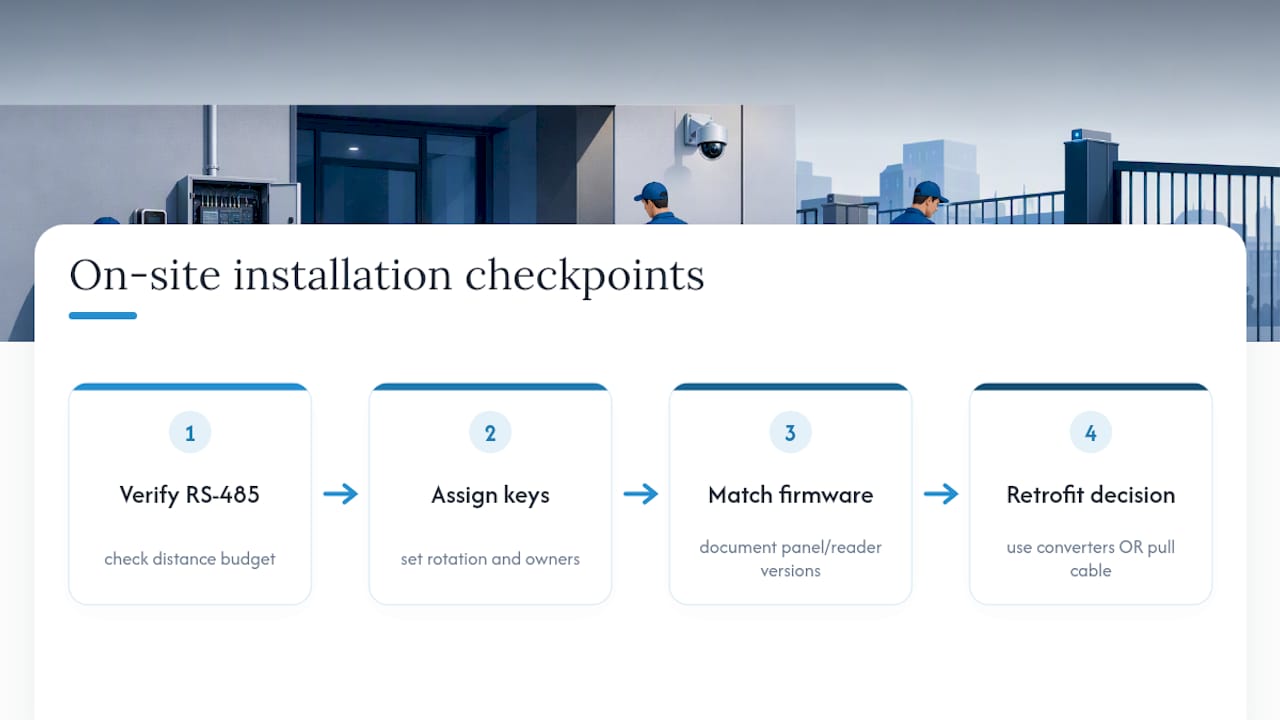
Converters earn their keep on sites with hundreds of doors and no budget for a same-year full swap. They're the wrong call when a facility is already gutting walls for a renovation. In that case, pull new RS-485 cable and skip the interim step entirely.
Testing should never be an afterthought bolted onto handover day. Scope it into the contract: supervision alerts, key provisioning proof, and a documented firmware version on every reader before signoff.
Facility teams weighing a system-wide upgrade can find installation and maintenance support through Fibertech's cabling and access control services, which covers everything from structured cabling to full ISMS integration.
— Samuel
Where to Verify These Standards Yourself
For the OSDP standard itself and SIA guidance, consult the Security Industry Association. For vendor-level migration reasoning, see the Axis white paper. For wiring and commissioning steps, review Genetec's technical documentation.